



As a part of the Science of Teaching (SoT) math research agenda, SoT funded three separate research projects and served as an advisor over their progression since December 2023.
The research projects will contribute to our knowledge of early grade numeracy teaching and learning (Grades 1-3) in Sub-Saharan Africa through delving into the following topics:
1. WhatsApp API-based CPD to improve teachers’ mathematical knowledge (South Africa)
2. Using co-creation to develop lessons/activities that support students’ problem-solving skills (Ghana)
3. Developing teachers’ competence in teaching mental mathematics in Grades 2 and 3 (South Africa)
4. Teachers’ understanding of learning progressions in foundational numeracy (Malawi)
5. What’s the buzz? Students discussing math ideas in groups (Tanzania)
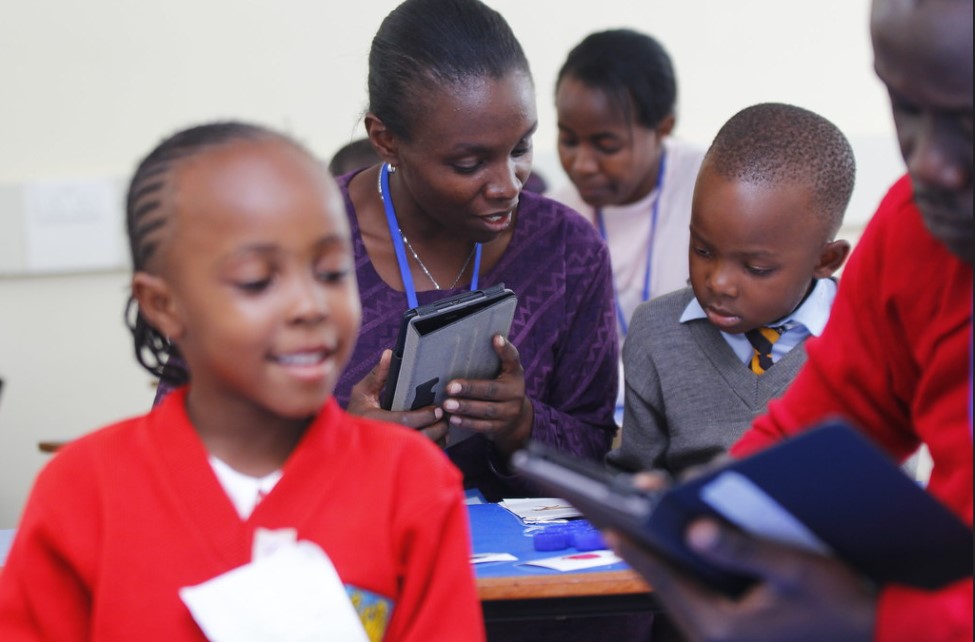
Within this hybrid WhatsApp-linked model, the study investigated the possibilities for improving primary teachers’ knowledge of early number in ways that the research base suggests are important for teaching. For design purposes, Ball et al’s (2008) model of mathematical knowledge for teaching (MKT) is utilized, where developing mathematical knowledge includes the core mathematical knowledge needed to complete tasks for oneself, the specialized knowledge required by teachers to make concepts understandable to others, and the awareness of progressions of ideas that are important for teaching.
 The Study Report
This research project adopted the core objective of co-creation in mathematics competence development and the design and integration of low-cost instructional materials in harnessing mathematics teaching and learning in schools. Through this model of mathematics education, educators, researchers, academics, and teachers come together to understand the status of primary school learners’ problem-solving competence and mathematical mindset and design lessons and activities that are context-specific and relevant to help improve learners’ learning experiences.
The Study Report
Click below to read the article "Teachers’, Researchers’, and Educators’ Partnerships: The Effect of Co-Creation on Pupils’ Problem-Solving Performance in Mathematics" published on this research.
The aim of this research project was to develop and explore the capacity of mathematics teachers to support Grades 2 and 3 teachers in their own schools to implement the tasks and resources package aimed at building Base-Ten thinking among learners, and to investigate learning gains through pre- and post-testing of learners in the classes of participating teachers compared to non-participating teachers (control group). Findings suggest that base-ten thinking encourages learners to use more sophisticated strategies to solve problems.
The Study Report
This study focused on teacher’s mathematical knowledge for teaching as it relates to students’ learning progressions. It examined how teachers grapple with their own knowledge about how students learn when confronted with a new curriculum that may or may not align with their own knowledge, and the ways they make sense of the new curriculum. This study took advantage of a unique moment in time, as primary teachers in Malawi are using a new set of teachers’ guides and student workbooks. These new materials are based on a large body of research on how students learn, and they integrate “best practices” for high-quality instruction. The study sought to understand how the new curriculum differed from the old curriculum in terms of learning progressions and how teachers understand and view these differences.
The Study Report
This study explores the use of Foundational Mathematics Knowledge for Teaching (FMKT) strategies in the context of flexible ability grouping (AG). The research project’s intervention design is based on the theory that if teachers receive training and follow-up support in three areas—AG, FMKT, and student-centered teaching approaches—then they will successfully apply these approaches to address the needs of struggling students, effectively teach foundational math, and exhibit student-centered approaches. The goal was to determine whether this combination could strengthen teachers’ ability to teach effectively in the early grades in selected schools in Tanzania.
The Study Report